This Blog is Dedicated to our dear friend Karen.
When she left this life she left a hole in our hearts as well as several to be read books.
We, her friends, will read these books for her.
This blog will be a sort of book club for us to post our thoughts and feelings about the stories and feelings we have of Karen while we read.

Tuesday, February 28, 2017

#86 Pulse by Patrick Carman

14760527
Meh. Faith is a kind of boring teenager, living in what's left of a boring town after most of society has moved into mega-cities. She goes to a mostly boring school, and not much exciting happens. She discovers that she's telekinetic, a slightly less boring boy named Dylan teaches her how to use this power, and they have a big fight with the kids who we knew were villains basically when we first met them.
This isn't bad, but it's also not that good. Pittacus Lore (!) said it had "pulse-pounding action"? Maybe in the last couple chapters, but otherwise it was pretty slow.


Saturday, February 25, 2017

#89 Scheisshaus Luck by Pierre Berg

3930572

4.5 stars rounded up to 5. A really good book.

I've read several books about the Holocaust and Nazi Germany's concentration camps - Elie Wiesel's Night, Roman Frister's The Cap, Heinz Heger's The Men with the Pink Triangle. Surprisingly, none of them brought home to me on a personal level the severity of conditions in the camps, like Berg's book has. The heavy labor, the randomness of why one person dies and another lives. The starvation-level rations - including days or weeks where the inmates scrounged for anything to eat - shoe leather, dandelions and grass, and (in at least one case) cannibalism of the recently deceased. And the constant emotional wearing down, so that witnesses to the cannibalism just sat and watched, unable to find the energy or empathy to stop the act.

While Wiesel's story is that of the Jewish experience, and Heger's from the viewpoint of a gay man, Berg's memoir is from the viewpoint of a French teenager who happens to be in the wrong place at the wrong time - the finest example of his "Shithouse Luck". (In fact, the "Scheisshaus Luck" of the title has two meanings - Berg's bad luck that causes him to be sent to Auschwitz, and the incredible instances of luck in that "shithouse" that made it possible for him to survive.) It was especially significant to me that, in addition to the groups we've known of that were sent to the camps - Jews, Romani, Communists, Jehova's Witnesses, criminals and political prisoners - the camps also included random citizens from Germany and the occupied countries, sent there by whim or as payback. The Auschwitz sub-camp of Monowitz (one of the four camps experienced by Berg) even had a contingent of British POWs - though, because of the Geneva Convention and regular Red Cross packages, conditions for them were far better than for the majority.

Although the memories in the book are Berg's, the completeness of the memoir is thanks to Berg's cowriter, Brian Brock, who took Berg's original manuscript, asked Berg questions to flesh out details, polished it, and helped to bring everything together in the final product. Both men admit it was a painful process, reliving (or, in Brock's case, forcing Berg to relive) the experience of the concentration camps. But the result is a stark, clear picture of everyday life in the camps.

Thursday, February 9, 2017

#50 The Rosie Project by Graeme Simsion

18015965

Definitely mixed feelings about this. On the one hand, for what it is - a romantic comedy about a man with (undiagnosed) Asperger Syndrome and his project to find the perfect mate - it's very well written. It's fun, at times funny, and romantic in places.
On the other hand, it often feels like Don's autism is used solely as a vehicle for comedy. And, while I'm not an expert in the subject, I question some of the information shared. Don feels the need to follow a strict routine; any deviation from the schedule causes him extreme discomfort (typical among those with autism). But the author implies that, with just a little effort, schedules and routines can be broken without any lasting repercussions. From my (limited) knowledge of Asperger's, I doubt that's the case.
It seems that Simsion had an opportunity here to tell a funny, engaging story, while at the same time giving factual information about autism; it appears (at least to me) that he didn't manage to do that.


Kris

Thursday, February 2, 2017

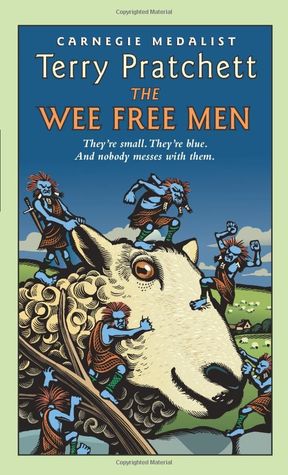
#418 The Wee Free Men by Terry Pratchett

34494

I've only ever read two other books by Terry Pratchett - Good Omens, which he cowrote with Neil Gaiman, and the first Discworld book, The Color of Magic. I really liked Omens, but at the time, I was all about Gaiman, so (because it was not entirely a Gaiman story) I didn't *love* it. And I didn't quite get Pratchett's humor when I read Color of Magic.
But, approaching this book, I was more receptive to the funny bits. This is (I think) partly because it's a Young Adult book, but it's also partly because of the Wee Free Men themselves - the Nac Mac Feegle. I mean, they help around the farm, like pixies, but they speak with a brogue, they wear kilts, and they're blue - they're not pixies, they're *pict-sies*! They're hilariously written, and they're a big part of why I enjoyed this book so much.


Kris

#288 The Lost Hero by Rick Riordon

7736182

Riordan's first series, Percy Jackson and the Olympians, dealt with the demigod children of the Greek gods. In this newer series, we're introduced to the idea that those Greek gods and their Roman counterparts are just different aspects of the same beings. This first book introduces us to three new kids - Jason, Piper, and Leo - and the chapters in the book alternate among their points of view. We're also introduced to a lot of new supporting characters, from other campers in the various cabins at Camp Half-Blood (give it up for my brothers and sisters in the Hypnos cabin!) to various gods and other figures from Greek mythology - most of whom are damaged versions of their legendary selves. Riordan does a good job of teaching readers about the true mythological figures and stories, while entertaining us with new action and humorous situations.

My only real complaints are that the story felt a bit slow at times, and that the girlfriend/boyfriend stuff between Jason and Piper was unnecessary.


Kris

Friday, January 27, 2017

#291 The Lake House by James Patterson

110444

The single worst book I've read by Patterson. So many ways that this is bad:

- A twelve-year-old girl and a boy of about the same age have sex. But it's ok, because they're bird-people and they mature at a different rate. Also, the girl lays two eggs. No one even knew she was, I don't know, pregnant? Is that what we call it?

- Frannie - the narrator - dies. It's not really a spoiler, because she gets better. I don't even understand this one. She's dead, and suddenly nurses are removing wires and tubes and stuff. Are these the same nurses who were working for the bad guy? And now they're helping revive Frannie?

- The bad guy. Or should I say "guys", because he has 4 or 5 clones who are also maybe robots? And he killed his wife and replaced her with a... robot? who performs oral sex on demand.

- really, the whole biotech angle of the story. Apparently they're able to "shuck" a donor; that is, they remove all the internal organs all in one piece. Like, altogether, all at once. Because science?

- bird people. human/bird hybrids.

- really, the worst part? Not the plot, or the made up science, or the crappy, anticlimactic climax. The worst part is the general writing. Here's a sample:

This was not good! Kit and I rode in the Suburban on a dirt road as far as it would take us, and fast. The damn trail just dead-ended into the mountain face. We were in the middle of nowhere. Smack dab.
Staring at a cold, hard rock face.
Not good at all.
"You could say that this is the end of the road," Kit quipped from his place behind the steering wheel. "Damn it. Damn Max."

There are so many things wrong with the book. And I don't understand why. I know Patterson can write reasonably well; I've read other books by him (alone and in collaboration with other writers) that are entertaining and well-written. But this one is so very bad.


Kris

Thursday, January 12, 2017

#98 Katya's World by Jonathan L. Howard


Katya's World (Russalka Chronicles, #1)

Not a great book. A decent book, yes, but not a great one.

During a great period of space colonization, the planet Earth sent residents of a region of Russia to populate a planet entirely covered by water. They would have given the planet a miss, but it's rich in minerals they need back on good old mother-Earth.

The aquatic geography of the planet is a key element in the story, in that everything has a naval feel to it. The people live in big underwater cities, and they travel everywhere by submarine. The claustrophobia and aquaphobia nodes in my brain tingle just thinking about it. But the maritime setting of the book actually leads to one of my complaints: there is so much navy-speak and so many technical terms and equipment related to water travel that I wasn't familiar with. The character Kane spends a good deal of time explaining Earth terms for the benefit of Katya, but the author doesn't do nearly as good a job explaining naval terms to the reader. As another reviewer pointed out, some of these terms and ideas (including the technology aboard the Leviathan) are so crucial to the action in the book that the reader needs to understand them well. I didn't understand them, so I found myself confused at points where the action was at its busiest.

I also was disappointed in some of the character development (or lack thereof). The author vaguely mentions that Katya's father died in the Terran-Russalkan War, and that her mother died as a result of an accident, and that's why she lives with her Uncle Lukyakin, but he doesn't give us much detail. Lukyakin himself fought in the War, and that's apparent when his battle skills resurface later in the book, but we don't know much more about his past. Kane has all kinds of issues and secrets, and some of those secrets are revealed, but things brought up early on are just left to fade away. (At one point, when it looks like Lukyakin has died, Kane offers sympathy to Katya. Katya tells him there's no way he could know the pain she's experiencing; his face blanches and he practically runs from the room. When another character learns what Katya has said, she implies that Kane has undergone huge tragedies himself, but we never hear more about it.)

Because the characterization is so simplistic, but the technical aspects are so advanced, there seem to be two books - one is a basic young adult dystopian novel, while the other is a more advanced science fiction novel. Neither of them is particularly well-written. And ultimately, that may be why - though I like the book - I don't *love* the book.
Kris