This Blog is Dedicated to our dear friend Karen.
When she left this life she left a hole in our hearts as well as several to be read books.
We, her friends, will read these books for her.
This blog will be a sort of book club for us to post our thoughts and feelings about the stories and feelings we have of Karen while we read.

Thursday, March 16, 2017

#68 The Girl of Fire and Rain by Rae Carson

10429092In general, a pretty good first book for a fantasy trilogy. I enjoyed the latin feel - including the use of Spanish (or at least a Spanish-influenced language). I also enjoyed the fact that Elisa starts off as this typical chubby, ineffectual princess and gradually becomes a strong, assertive leader. There was a strong religious element to the story, as well; again, it really worked well by creating a sort of Spanish Catholic feel (if that makes sense).
The idea of Elisa being chosen by God, and marked as His with a Godstone jewel, was interesting. But having that jewel sticking out of her navel was just weird. And late in the book there's a really strange scene with the Godstone that just makes the story lose a lot of credibility. A true wtf moment.
I'm interested to see where the story goes, so I'll probably come back to this series when I have the chance. Not a must-read situation, but a good enough tale that I'm ready to give it some more attention.

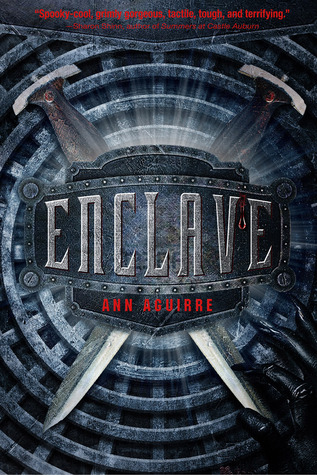


#166 Enclave by Ann Aguire

7137327
This is well-written post-apocalyptic fiction. The first part of the story takes place in an underground settlement. The residents are divided into three categories: breeders, builders, and hunters. The hunters scavenge for food and protect the settlement from predators; the builders provide everything the settlement needs, from weapons to medicines to clothing; and the breeders provide... the next generation of citizens. If you don't provide something to the community - if you're too old, or too weak, or handicapped in some way - you're a drain on the settlement, and you're banished to the tunnels outside its barricades (where you won't last long, since you'll be attacked by the Freaks).
Deuce, the narrator, is a newly initiated Hunter who has a hard time following orders. To teach her a lesson, the Elders accuse her friend of hoarding; Deuce takes the blame instead, and is banished, along with her hunting partner, Fade. Instead of fighting the Freaks, they decide to take their chances above-ground, in the ruined city of New York. Most of the remainder of the book covers their adventures in New York and their journey out of the city in search of a safe place to live.
I enjoyed the descriptions of each of the "worlds". The author obviously spent a great deal of time researching and thinking about how an apocalyptic event would affect not only the city above, but also the subway tunnels and other underground spaces. (She discusses some of that process in a note at the end of the book.) She also did a good job showing how the collapse of modern society would affect the people that survived - from Deuce's enclave, to the gangs in above-ground New York, to others they meet outside the city.
The story reminded me a bit of Cormac McCarthy's The Road , but is not quite to the level of that book. McCarthy does a better job of showing the emotional and psychological strain caused by the constant struggle for survival - from searching for food and water, to defending against attacks by wildlings and poachers, down to even wondering if things will ever improve.


#12 My Mother's Secret by JL Witterick

18167456

Short novel based on the true experiences of Franciszka Halamajowa and her daughter, Helena, during World War II Poland. Four sections, each relating the events from the point of view of a different narrator - Helena; Bronek, a Jewish man whose family is hidden by the Halamajowa family; Mikolaj, a young Jewish boy whose family is also hidden by the Halamajowas; and Vilheim, a German soldier and pacifist hidden by the family. A fourth section picks up Helena's story again, after we've been introduced to all the other characters, and follows the story through to the end of the war.
The story, while fiction, is written in the form of a memoir (or series of memoirs); it is not an "exciting" or suspenseful book, in that there is not a lot of action, but there is certainly an element of suspense in that any or all of the characters could have been discovered at any time - which would have meant the death of all of them.
The book is plainly written; although I found it in the adult fiction section of the library, it could very easily be read by a teen or even someone in middle school or junior high. While the subject matter of the Holocaust is pretty heavy, there is nothing in the book that would be inappropriate or difficult to deal with for a younger reader. In fact, I felt the book belonged in the library's Young Adult or Juvenile section, instead of the Adult section. (In her Acknowledgements, the author mentions several of the people she had pre-read the book either mentioning it was a good book for children, or being children or young adults themselves.)
It was interesting to know that the book was based on real people and events. As the epilogue says, before the war, the village of Sokal, Poland held over 6,000 Jews - after the war, only 30 survived. The Halamajowa women hid 15 Jews (and one German soldier) in their home for most of the war - fully half of the survivors of the war. I would have liked to have seen more information on what happened to the real people that survived the war - if there was a real Mikolaj, a real Bronek. Aside from that, this was a good, short book.
 

Thursday, March 2, 2017

#129 Pillage by Obert Skye

2775759

A decent book. Beck's mother dies, and he's sent to live with his rich but eccentric uncle. He rarely sees his uncle, and is looked after by the loyal family retainers, who mostly leave him to his own devices - which means he spends most of his free time exploring the parts of the mansion he's been told to stay out of.
Of course, this means he eventually discovers his family's dark secret - they can manipulate plants. Oh yeah, and there are dragons.
Some good plot twists and turns, and the characters were (mostly) likable. There was a little bit of teen romance, but it's not shoved down your throat like in some books. Pleasantly free (mostly) of teen angst, too.
This was in my library's young adult section, but I think a lot of juvenile readers would find it easy to read, as well.
 

Tuesday, February 28, 2017

#86 Pulse by Patrick Carman

14760527
Meh. Faith is a kind of boring teenager, living in what's left of a boring town after most of society has moved into mega-cities. She goes to a mostly boring school, and not much exciting happens. She discovers that she's telekinetic, a slightly less boring boy named Dylan teaches her how to use this power, and they have a big fight with the kids who we knew were villains basically when we first met them.
This isn't bad, but it's also not that good. Pittacus Lore (!) said it had "pulse-pounding action"? Maybe in the last couple chapters, but otherwise it was pretty slow.


Saturday, February 25, 2017

#89 Scheisshaus Luck by Pierre Berg

3930572

4.5 stars rounded up to 5. A really good book.

I've read several books about the Holocaust and Nazi Germany's concentration camps - Elie Wiesel's Night, Roman Frister's The Cap, Heinz Heger's The Men with the Pink Triangle. Surprisingly, none of them brought home to me on a personal level the severity of conditions in the camps, like Berg's book has. The heavy labor, the randomness of why one person dies and another lives. The starvation-level rations - including days or weeks where the inmates scrounged for anything to eat - shoe leather, dandelions and grass, and (in at least one case) cannibalism of the recently deceased. And the constant emotional wearing down, so that witnesses to the cannibalism just sat and watched, unable to find the energy or empathy to stop the act.

While Wiesel's story is that of the Jewish experience, and Heger's from the viewpoint of a gay man, Berg's memoir is from the viewpoint of a French teenager who happens to be in the wrong place at the wrong time - the finest example of his "Shithouse Luck". (In fact, the "Scheisshaus Luck" of the title has two meanings - Berg's bad luck that causes him to be sent to Auschwitz, and the incredible instances of luck in that "shithouse" that made it possible for him to survive.) It was especially significant to me that, in addition to the groups we've known of that were sent to the camps - Jews, Romani, Communists, Jehova's Witnesses, criminals and political prisoners - the camps also included random citizens from Germany and the occupied countries, sent there by whim or as payback. The Auschwitz sub-camp of Monowitz (one of the four camps experienced by Berg) even had a contingent of British POWs - though, because of the Geneva Convention and regular Red Cross packages, conditions for them were far better than for the majority.

Although the memories in the book are Berg's, the completeness of the memoir is thanks to Berg's cowriter, Brian Brock, who took Berg's original manuscript, asked Berg questions to flesh out details, polished it, and helped to bring everything together in the final product. Both men admit it was a painful process, reliving (or, in Brock's case, forcing Berg to relive) the experience of the concentration camps. But the result is a stark, clear picture of everyday life in the camps.

Thursday, February 9, 2017

#50 The Rosie Project by Graeme Simsion

18015965

Definitely mixed feelings about this. On the one hand, for what it is - a romantic comedy about a man with (undiagnosed) Asperger Syndrome and his project to find the perfect mate - it's very well written. It's fun, at times funny, and romantic in places.
On the other hand, it often feels like Don's autism is used solely as a vehicle for comedy. And, while I'm not an expert in the subject, I question some of the information shared. Don feels the need to follow a strict routine; any deviation from the schedule causes him extreme discomfort (typical among those with autism). But the author implies that, with just a little effort, schedules and routines can be broken without any lasting repercussions. From my (limited) knowledge of Asperger's, I doubt that's the case.
It seems that Simsion had an opportunity here to tell a funny, engaging story, while at the same time giving factual information about autism; it appears (at least to me) that he didn't manage to do that.


Kris

Thursday, February 2, 2017

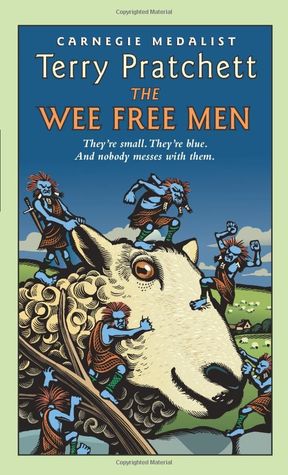
#418 The Wee Free Men by Terry Pratchett

34494

I've only ever read two other books by Terry Pratchett - Good Omens, which he cowrote with Neil Gaiman, and the first Discworld book, The Color of Magic. I really liked Omens, but at the time, I was all about Gaiman, so (because it was not entirely a Gaiman story) I didn't *love* it. And I didn't quite get Pratchett's humor when I read Color of Magic.
But, approaching this book, I was more receptive to the funny bits. This is (I think) partly because it's a Young Adult book, but it's also partly because of the Wee Free Men themselves - the Nac Mac Feegle. I mean, they help around the farm, like pixies, but they speak with a brogue, they wear kilts, and they're blue - they're not pixies, they're *pict-sies*! They're hilariously written, and they're a big part of why I enjoyed this book so much.


Kris

#288 The Lost Hero by Rick Riordon

7736182

Riordan's first series, Percy Jackson and the Olympians, dealt with the demigod children of the Greek gods. In this newer series, we're introduced to the idea that those Greek gods and their Roman counterparts are just different aspects of the same beings. This first book introduces us to three new kids - Jason, Piper, and Leo - and the chapters in the book alternate among their points of view. We're also introduced to a lot of new supporting characters, from other campers in the various cabins at Camp Half-Blood (give it up for my brothers and sisters in the Hypnos cabin!) to various gods and other figures from Greek mythology - most of whom are damaged versions of their legendary selves. Riordan does a good job of teaching readers about the true mythological figures and stories, while entertaining us with new action and humorous situations.

My only real complaints are that the story felt a bit slow at times, and that the girlfriend/boyfriend stuff between Jason and Piper was unnecessary.


Kris

Friday, January 27, 2017

#291 The Lake House by James Patterson

110444

The single worst book I've read by Patterson. So many ways that this is bad:

- A twelve-year-old girl and a boy of about the same age have sex. But it's ok, because they're bird-people and they mature at a different rate. Also, the girl lays two eggs. No one even knew she was, I don't know, pregnant? Is that what we call it?

- Frannie - the narrator - dies. It's not really a spoiler, because she gets better. I don't even understand this one. She's dead, and suddenly nurses are removing wires and tubes and stuff. Are these the same nurses who were working for the bad guy? And now they're helping revive Frannie?

- The bad guy. Or should I say "guys", because he has 4 or 5 clones who are also maybe robots? And he killed his wife and replaced her with a... robot? who performs oral sex on demand.

- really, the whole biotech angle of the story. Apparently they're able to "shuck" a donor; that is, they remove all the internal organs all in one piece. Like, altogether, all at once. Because science?

- bird people. human/bird hybrids.

- really, the worst part? Not the plot, or the made up science, or the crappy, anticlimactic climax. The worst part is the general writing. Here's a sample:

This was not good! Kit and I rode in the Suburban on a dirt road as far as it would take us, and fast. The damn trail just dead-ended into the mountain face. We were in the middle of nowhere. Smack dab.
Staring at a cold, hard rock face.
Not good at all.
"You could say that this is the end of the road," Kit quipped from his place behind the steering wheel. "Damn it. Damn Max."

There are so many things wrong with the book. And I don't understand why. I know Patterson can write reasonably well; I've read other books by him (alone and in collaboration with other writers) that are entertaining and well-written. But this one is so very bad.


Kris

Thursday, January 12, 2017

#98 Katya's World by Jonathan L. Howard


Katya's World (Russalka Chronicles, #1)

Not a great book. A decent book, yes, but not a great one.

During a great period of space colonization, the planet Earth sent residents of a region of Russia to populate a planet entirely covered by water. They would have given the planet a miss, but it's rich in minerals they need back on good old mother-Earth.

The aquatic geography of the planet is a key element in the story, in that everything has a naval feel to it. The people live in big underwater cities, and they travel everywhere by submarine. The claustrophobia and aquaphobia nodes in my brain tingle just thinking about it. But the maritime setting of the book actually leads to one of my complaints: there is so much navy-speak and so many technical terms and equipment related to water travel that I wasn't familiar with. The character Kane spends a good deal of time explaining Earth terms for the benefit of Katya, but the author doesn't do nearly as good a job explaining naval terms to the reader. As another reviewer pointed out, some of these terms and ideas (including the technology aboard the Leviathan) are so crucial to the action in the book that the reader needs to understand them well. I didn't understand them, so I found myself confused at points where the action was at its busiest.

I also was disappointed in some of the character development (or lack thereof). The author vaguely mentions that Katya's father died in the Terran-Russalkan War, and that her mother died as a result of an accident, and that's why she lives with her Uncle Lukyakin, but he doesn't give us much detail. Lukyakin himself fought in the War, and that's apparent when his battle skills resurface later in the book, but we don't know much more about his past. Kane has all kinds of issues and secrets, and some of those secrets are revealed, but things brought up early on are just left to fade away. (At one point, when it looks like Lukyakin has died, Kane offers sympathy to Katya. Katya tells him there's no way he could know the pain she's experiencing; his face blanches and he practically runs from the room. When another character learns what Katya has said, she implies that Kane has undergone huge tragedies himself, but we never hear more about it.)

Because the characterization is so simplistic, but the technical aspects are so advanced, there seem to be two books - one is a basic young adult dystopian novel, while the other is a more advanced science fiction novel. Neither of them is particularly well-written. And ultimately, that may be why - though I like the book - I don't *love* the book.
Kris

Wednesday, December 28, 2016

#411 Be The Pack Leaderby Cesar Millan

119926


(Read as part of our "Reading with Karen" project. I'm kind of surprised she had this book on her to-read list, since her Yorkie Chubbs is such an incredibly good dog. Maybe she watched some of Cesar's show and wanted to learn more about him.)

So many people try to deal with their dogs (and other animals) from a human reference point. They think animals think of things in the same way as humans, and that's just not the case. For example, dogs are pack animals, and they approach things from that pack animal mentality - where do I fit into the pack? What is my "job" in the pack? Who is the pack leader?
On his television show, Dog Whisperer, Cesar Millan helps people address problems with their dogs by approaching the problem from that same pack mentality - whether it's a dog not recognizing the "alpha dog" status of its owner, or a dog who's stressed out about conflict among the humans in the household, for example. This book is essentially Millan explaining how pack animals think, and showing readers how to establish themselves as the pack leader in their dogs' minds.
One of the main points made throughout the book is that dogs respond to the energy and non-verbal communication put out by their owners. You place yourself as the pack leader, and keep your dogs from being stressed out, by putting out calm, assertive energy. Millan gives lots of great examples of how this helps you to work out problems with your dogs, but I wish he had done a better job explaining how to project that calm-assertive energy.
There are a few other minor issues that I have with the book, but for the most part, it's a good resource for people trying to establish a strong, respectful relationship with their dog.

Kris

Tuesday, December 13, 2016

#287 Button Button Uncanny Stories by Richard Matheson

754250

As with any collection of short stories, there are some that really shine,and others that... don't. "Button, Button" is classic Matheson, with that Twilight Zone feel that made him such an important contributor to that show. "Shock Wave" has a similar feel to it. "A Flourish of Strumpets" was a funny take on door-to-door prostitution. "Tis the Season to Be Jelly" was just... strange. But the best piece, in my opinion, was the only poetry piece in the book: "The Jazz Machine".         

Monday, December 5, 2016

#419 Sense and Senibility by Jane Austin

14935

Finally finished this, after over a month of reading it. I read Wuthering Heights not long ago, and it didn't give me *too* much trouble, so I thought this one would be relatively easy. I was so wrong.
First off, Austen's writing is so difficult to follow. Each sentence must have a minimum of eight commas, and there are so many instances of adjectives or clauses not being put anywhere near the word they're describing. There is also Austen's annoying habit of referring to people as "Mrs. So-and-so", but providing no clue as to which of the married women with that surname she is referring. For instance, there are two Mrs. Dashwoods, three Miss Dashwoods, two Miss Steeles, two Mr. Ferrars, etc., etc. This makes things so confusing for the reader. And as I mentioned in my review of Wuthering Heights, I needed a scorecard to understand the interrelationships among the various families: The Dashwood sisters' half brother is married to the Ferrar brothers' sister, and the Steele sisters are somehow related to someone, and Sir John is somebody's cousin, and I don't know what else. And understanding all these relationships is crucial to understanding the plot.


To me, the only redeeming factor was the sense of satisfaction I got when I understood one of Austen's little jokes. And, of course, the satisfaction of finally finishing the book.


Kris

Tuesday, November 29, 2016

#362 The Princess Diaries by Meg Cabot

38980

I enjoyed Anne Hathaway's audio version of this book.  A girl didn't know she was a princess until her father found out he couldn't have anymore children (heirs) so they decided to tell her she was a princess.  The drama unfolds of a teenager finding out she is a princess.  It's a cute book for tweens.

Monday, November 7, 2016

#220 Heart of the Matter by Emily Griffin

7114761

This is the first of Karen's books I couldn't finish.  It was just so bad.  And I began this project saying no matter what I would finish the books for her, and I plan to try and keep that promise, but I guess there will have to be some exceptions.  If anyone wants to pick this one up and finish the last quarter of the book, please do so.

Anyhow, we have three main characters.  The bored housewife, her husband which happens to be a very successful plastic surgeon and Valerie, a single-mom who's son was severally burned and is a patient of the plastic surgeons.  The plastic surgeon and Valerie end up having an affair.  The bored housewife questions her choice of staying at home and how she feels different than all the other stay at home parents and perhaps if she didn't stay at home her husband would not have had an affair.  Gah.  I can't even take it.  It was a self indulgent soap opera.  I wonder if this book would be one left on Karen's nightstand with a bookmark in it with intentions of getting back to it....never. 

Thursday, November 3, 2016

#74 The Kill Order by James Dashner

The Kill Order (Maze Runner, #.5)

When I started reading the book, I kept waiting for the characters from the original trilogy to show up. Who are these people, Mark and Trina? Where's Thomas and the other Gladers? Of course, if I'd just read the book jacket, I'd have realized that this is a prequel; all the events in this book happen long before the Maze Runner events.

I really enjoyed the original trilogy, but didn't care for this one as much. It seems like Dashner's whole plan for this book was to throw Mark and the others into crisis scenario after crisis scenario. And so much violence, especially after the virus starts making everyone go crazy. So, not just protecting-our-territory violence, but crazy, smashing-someone's-head-into-a-wall-because-why-not violence. Over and over again.
The book does have some redeeming qualities: we get to find out what happened right after the solar flares that started the whole thing, for instance. And Mark and Trina's kinda sorta romance is sweet.


Kris

Sunday, October 23, 2016

#24 The Impossible Knife of Memory by Laurie Halse Anderson

18079527

A pretty decent read overall. Yes, there is some teen angst, and some teen everyone-is-zombies-and-I-hate-the-world, but the book also gives a very clear (and, it seems to me, accurate) depiction of both Andy's war-related PTSD and Hayley's anxiety attacks. I would have liked a little more of Finn's storyline - maybe a Hayley/Finn alternating chapter thing - but really the emphasis is on Hayley and her father and the heavy emotional and psychological issues they're dealing with.
I definitely think Karen would have liked this one. Not only for the big issues covered, but also just for the nerd love between Hayley and Finn. I wanted to wrap them up (with a big unzipped sleeping bag) and protect them from everything.


Kris

#304 Sam's Letters to Jennifer by James Patterson

80568


Let me get a couple little quibbles out of the way, because I really, truly liked this book.

First, and I know I keep harping on this, but James Patterson is not a great writer of dialog. Some of the lines he gives these characters, especially toward the beginning of the book, are full-on hack writing.

Secondly. You know the thing in the movies, product placement, where the film company gets money from a company for showing its product in the film? Like Bruce Willis is fighting the bad guys in a Die Hard movie, and he stops to pop open a delicious frosty can of Coke? I swear Patterson has a similar kind of deal going. He not only tells us that Jennifer drives a Jaguar, he tells us it's a midnight blue '96 Jaguar Vanden Plas (whatever that means), with dual gas tanks. Jennifer smokes Newport Lights, drinks Uncommon Ground takeout coffee, and listens to Ella Fitzgerald, not just on her stereo, but on her Bose. Patterson tells us all this in the space of 2-3 pages, most of it in 2-3 lines of the first chapter of the book. Luckily, he cools it with the product placement later in the story, because the blatant product name-dropping would have been soooo annoying right in the middle of what turns out to be a beautiful love story. Actually, a pair of love stories, because (as the title suggests), Jennifer's grandmother Sam has written her a series of letters (that are interspersed among the regular chapters) telling her own tale of true love.

I know, "telling her own tale of true love" - sounds pretty sappy and saccharine sweet. Luckily, and a little surprisingly, the two love stories shared by Patterson are not sappy and saccharine sweet; they're beautifully written, a little funny at times, with moments that made me smile and moments that (almost) made me cry.

As with most books I've read over the last coupla years, this was part of our Reading with Karen project, where we're reading the to-read list of my late sister. Would Karen have liked this? No. She would have loved this! It would have left her (to use her own expression) bawl-bagging, crying big

tears and sad tears both.

Kris


Wednesday, October 12, 2016

#43 Poison Study by Maria V. Snyder


Poison Study (Study, #1)
Although I found this book in my library's Adult Sci Fi/Fantasy section, it had a very Young Adult feel to it, for the most part. However, there are a few places where I was reminded that this is an adult-level book - including the point where Yelena and consummate their relationship. There's no explicit sex in the book, but it's clear from the text that they do have sex. Also, since Valek is an assassin and a spy, there's an above-average amount of killing in the book. Add to that the fact that one of the main characters had been raped (prior to the events in the book), and the psychological torture committed on one of the characters, and this is possibly a bit too adult a book for young teens.

Of course, this was right up my alley - not the rape and torture and maiming and killing, but the magic and swords and whatnot. Yelena, condemned to be executed for murdering the son of her benefactor, is given the opportunity by Valek to become the food taster for the Commander, the country's leader. Since plots and intrigues abound, there is a very real chance that she will be poisoned, so by saying yes, she may have only postponed her death. Working for Valek, she is soon caught up in all the aforementioned plots and intrigues, while also trying to avoid attempts on her own life by people hired by her former benefactor. Add some magicians, some nasty-sounding spiders, a snow cat or two, and it's pretty exciting stuff


Kris